Tuesday, November 8, 2016

Creole Languages: yiddish, Spanglish? Ebonics?

The structure and function of Creole Languages

  • the process of pidginization
    • simplification and reduction
  • the process of creolization
    • elaboration and expansion
  • the post-creole continuum
    • ongoing interaction with language of power


How Yiddish Could Save the Jewish People

INTERVIEW...Culture & Yiddish

Language, Not Marriage or Religious Practice, Key to Continuity

Passport to Peoplehood: Learning Yiddish gave Jordan Kutzik a better crash course on being Jewish than any day school could offer.
riverside films
Passport to Peoplehood: Learning Yiddish gave Jordan Kutzik a better crash course on being Jewish than any day school could offer.

By Jordan Kutzik

The American Jewish community and its media frequently express concern about the Jewish future in America, citing mounting rates of assimilation and increasingly liberal trends in religious practice. In this discussion, intermarriage is frequently conceived of as being both the standard measure and the primary symptom of just how assimilated Jews are. What is usually left out of the discussion is any mention of linguistic assimilation.

In fact, most American Jews conceive of the Jewish people as being a religious group but rarely note the important role that Jewish ethnic and cultural heritage as expressed through language has traditionally played in Jewish survival.

The fact that many Jews cannot even conceive of ways of maintaining and transmitting their identity other than through religion testifies to the fact that outside of their religious affiliation, the vast majority of Jews are, culturally and linguistically speaking, hardly different from other Americans.

While religion has always played a central role in Jewish identity, Jews have also traditionally identified as not just members of the wider Jewish people, but also of specific Jewish ethnicities defined by Jewish languages. These languages, along with their respective cultures, foods and folklores, were, for the majority of Jewish history, the primary mechanism by which Jewish continuity was preserved. The knowledge of YiddishLadino or one of the other Jewish languages of the Diaspora (for example, Bukhari, Judeo-TatJudeo-Aramaic) marked one’s identity as a member of the group. There was less need for debate about who was and was not a Jew. Whether a person was religious, a closeted heretic or an open Epicurus, she was a Jew if she spoke a Jewish language as her mother tongue.
  • connections to Jewish heritage are typically through Jewish culture rather than religion:
    •  learning Yiddish and Hebrew songs, hearing klezmer music, reading Sholom Aleichem’s stories, and cooking kugel and matzo brei with my mother.
  • Languages are not just vehicles for communication; they are the storehouse in which culture, tradition and wisdom reside. Languages are the lifeblood of a people. For Jewish people, uniquely Jewish languages and cultures also served as the body in which the religious soul resided and was reproduced across the generations.  
  • Jewish values are so built into the language that even the most mundane conversations in Yiddish about politics or sports feel more Jewish to most than conversations about the Talmud in English. 
    • This is because the idioms used to praise, to condemn and lampoon are often in and of themselves quotations from Jewish scripture. A good example: “vi esroygim nokh sukes” (like etrogs after Sukkot— that is, objects that had already fulfilled their purpose and were now useless).
Learning a Jewish language, of course, is not a magic bullet in the fight for Jewish survival and should not serve as the sole basis of Jewish education. But at a time when a high rate of Jewish intermarriage outside Orthodox communities is a given, religion alone doesn’t guarantee Jewish continuity. And at a time when the internal Jewish communal dialogue around Israel is increasingly polarized and off-putting, Israel alone is not enough to guarantee Jewish continuity in America. We need an element that has kept us together no matter what we are saying to one another. It might be time to turn to language to bond us as a people.

Spanglish: Identity Preservation or Language Destruction?

Awesome Power Point on Issues

Living in Spanglish (watch)


language is not only a method of communication, but also an element that represents our cultural identity. If it is precisely our cultural inheritance the component that we intend to protect by teaching our language to our children, why [intentionally] destroy the shared core of our cultures?

Spanglish is informal due to the lack of structure and set rules. From a linguistic point of view, Spanglish often is mistakenly labeled many things.
  • Spanglish is not a creole or dialect of Spanish, because although people claim to be native speakers of Spanglish, Spanglish itself has not yet become a language on its own but speakers speak English or Spanish with a heavy influence of the other language. 
  • Spanglish is the fluid exchange of language between English and Spanish, present in the heavy influence in the words and phrases used by the speaker. 
  • Spanglish is currently considered a hybrid language by linguists—many actually refer to Spanglish as "Spanish-English code-switching", though there is some influence of borrowing, and lexical and grammatical shifts as well.
The inception of Spanglish is due to the influx of Latin American people into North America, specifically the United States of America. Spanglish can be separated into two different categories: code switching or borrowing, and lexical and grammatical shifts.
  • For example, a fluent bilingual speaker addressing another bilingual speaker might engage in code switching with the sentence, "I'm sorry I cannot attend next week's meeting porque tengo una obligación de negocios en Boston, pero espero que I'll be back for the meeting the week after"—which means, "I'm sorry I cannot attend next week's meeting because I have a business obligation in Boston, but I hope to be back for the meeting the week after."

Identity and Spanglish

The usage of Spanglish is often associated with an individual's association with identity (in terms of language learning) and reflects how many minority-American cultures feel toward their heritage. Commonly in ethnic communities within the United States, the knowledge of one's heritage language signifies if one is truly of a member of their culture.
  • Just as Spanish helps individuals identify with their Spanish identity, Spanglish is slowly becoming the poignant realization of the Hispanic-American's, especially Mexican-American's, identity within the United States. 
  • Individuals of Hispanic descent living in America face living in two very different worlds and need a new sense of bi-cultural and bilingual identity of their own experience. 
  • Living within the United States creates a synergy of culture and struggles for many Mexican-Americans. The hope to retain their cultural heritage/language and their dual-identity in American society is one of the major factors that lead to the creation of Spanglish. 

Attitudes Towards Spanglish

Spanglish is a misunderstood skill because often times, “pure” Spanish speakers denounce Spanglish. In fact, Spanglish is not about necessarily assimilating to English—it is about acculturating and accommodating. Still, Spanglish has variously been accused of corrupting and endangering the “real” Spanish language, and holding kids back, though linguistically speaking, there is no such thing as a "pure" or "real" language.
  • Presently, “Spanglish” is still viewed by most as a rather derogatory and patronizing word to its community because it seems like a “bastardized language”. In reality, Spanglish has its own culture and has a reputation of its own. 
  • It is commonly assumed that Spanglish is a jargon: part Spanish and part English, with neither gravitas nor a clear identity, says the author of Spanglish and proponent of Spanglish, Ilan Stavans. 
  •  Use of the word Spanglish reflects the wide range of views towards the mixed language in the United States. 
    • In Latino communities, the term Spanglish is used in a positive and proud connotation by political leaders. 
    • It is also used by Linguists and scholars promoted for use in literary writing. 
    • Despite the promotion of positive usage of the term by activists and scholars alike, the term is often used with a negative connotation disparagingly. 
      • People often refer to themselves as 'Spanglish speakers' if they do not speak Spanish well. 
      • The term Spanglish is also often used as a disparaging way to describe individuals that do not speak English fluently and are in the process of learning, assuming the inclusion of Spanglish as a lack of English fluency.

Non-verbal communication & gender

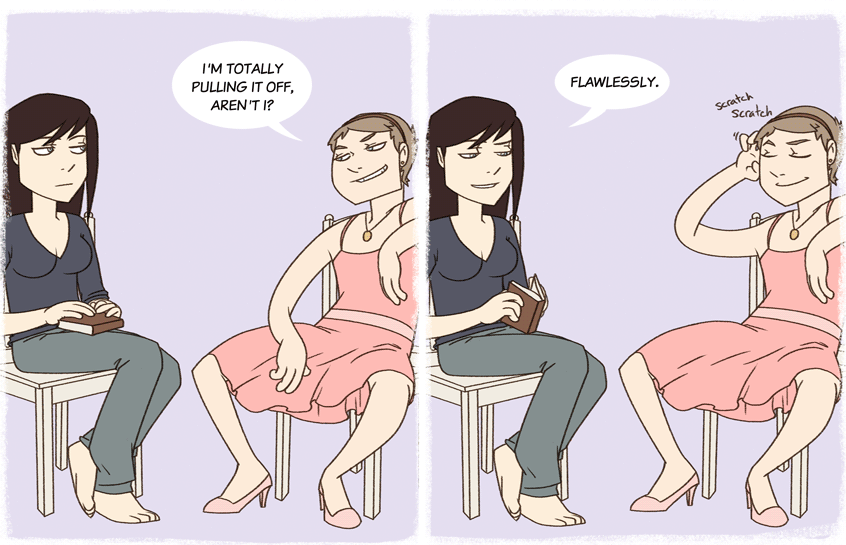
Philosopher Sandra Lee Bartky once observed that being feminine often means using one’s body to portray powerlessness.  These gendered postures are LEARNED and are not reflected in the preadolescence class photo above.
  • A feminine person keeps her body small and contained; she makes sure that it doesn’t take up to much space or impose itself.  
  • She walks and sits in tightly packaged ways.  
  • She doesn’t cover the breadth of the sidewalk or expand herself beyond the chair she occupies.
Screenshot_1
.
Likewise, burping and farting, raising one’s voice in an argument, and even laughing loudly are considered distinctly unfeminine.
  • A feminine person doesn’t use her body to forcefully interact with the world, she lets others do for her when possible.  “Massiveness, power, or abundance in a woman’s body is met with distaste,” Bartky wrote.
Stunningly, when you think about it, these features of feminine body comportment are, in fact, not uniquely feminine, but associated with deference more generally.  Bartky again:
In groups of men, those with higher status typically assume looser and more relaxed postures; the boss lounges comfortably behind the desk while the applicant sits tense and rigid on the edge of his seat.  Higher-status individuals may touch their subordinates more than they themselves get touched; they initiate more eye contact and are smiled at by their inferiors more than they are observed to smile in return.  What is announced in the comportment of superiors is confidence and ease…
Acting feminine, then, overlaps with performances of submissiveness.
  • Both men and women use their bodies in more feminine ways when their interacting with a superior, whether it be their boss, their commander, a police officer, or their professor.
  • Psychologist Andy Yap and his colleagues tested whether “expansive body postures” like the ones associated with masculinity increase people’s sense of powerfulness and entitlement.  They did.  In laboratory experiments, people who were prompted to take up more space were more likely to steal, cheat, and violate traffic laws in a simulation.  A sense of powerfulness, reported by the subjects, mediated the effect (a robust finding that others have documented as well).
  • large automobiles with greater internal space were more likely than small ones to be illegally parked in New York City.
Research, then, has shown that expansive body postures that take up room instill a psychological sense of power and entitlement.  The fact that this behavior is gendered may go some way towards explaining the persistence of gender inequality and, more pointedly, some men’s belief that they have earned their unearned privileges.

Language & Gender


Language and Gender
Units of analysis:
·         Gender Exclusive Versus Gender Preferential Language Differences
o   Arawak/Carib
o   Men’s languages (secret languages) associated with patrilineal cultures (LONGHOUSE)
o   Trade jargons?
o   Where they exist, reflect gender exclusive roles
·         Sex PREFERENTIAL  Problems: Sexism in Language
---Is language sexist or is culture sexist
o   Gender INCLUSIVE language (from psychology text)
"The intent of this is to highlight a few areas where we still find exclusivity or a sense of hierarchy in the use of language to place one group of people below others, creating or perpetuating negative social stereotypes.
Given the spirit of inclusivity in our culture, some suggestions are provided here to avoid derogatory language. The examples are by no means comprehensive, but serve to remind us of areas where language discrimination still exists and causes unnecessary misunderstandings in our daily communication with the general public. The spirit of the "title" can be summed up in three general principles:
  • Don't single out a person's sex, race, ethnicity, or other personal traits or characteristics (such as sexual orientation, age, or a disability) when it has no direct bearing on the topic at hand. In other words, don't create or promote stereotype based on unavoidable human characteristics.
  • Be consistent in your description of members of a group: Don't single out women to describe their physical beauty, clothes or accessories or note a disabled person's use of an aid, or refer to the race of the only minority in a group unless it is at that individual's request.
  • Keep in mind that use of inclusive language is for general cases. Direct requests by individuals take precedence over general rules (e.g., Mrs. John Doe requests that her own name not be used). "

    • Making Distinctions: The good, the bad & the ugly
      • Mailman?
      • Actor/waiter/steward/mailman VS  doctor/lawyer/professor/president
      • Are there gender neutral pronouns? (guys in Philadelphia)
    • Designating Status & Hierarchy:
      • Does Language REFLECT gender relations?
      • Does Language CREATE gender distinctions?
      • A bit of both?
Explanations for Differences:
    • SOCIAL STATUS EXPLANATIONS: women are more status conscious than men
    • WOMEN AS GUARDIANS OF SOCIAL VALUES
        • Better behavior is expected of women
        • Little boys are allowed more freedom than little girls in speech and other socially acceptable behavior
    • SUBORDINATE GROUP MUST BE POLITE
        • Looking for status recognition in larger society
        • Protecting “face” (Goffman)/avoiding offence to others
        • Children (less power & status) also expected to use polite forms
    • VERNACULAR FORMS EXPRESS MACHISMO
        • Solidarity
        • Carry covert prestige for men (but not for women)
        • Standard forms are associated with femininity (covert power for women)
        • Rejection of “school marm” (taught) speech by female teachers
    • OBSERVER’S BIAS
        • Women interviewed want to make a better impression (aware of status marked setting)
        • Women’s “social class” may be misidentified as her husband’s
      • Signaling Gender
        • Structural differences
          • Pronunciation
          • Grammar
          • Lexicon
        • Homosexual speech
    • Women’s Speech: Characteristics
      • General
        • Conservative (more standard)
          • Crossover phenomenon
          • Way to advance status as lower status gender?
          • Raise children-provide good language role model?
        • Polite/formal
        • Nonverbal communication
          • Kinesics
          • Proxemics
          • Touching (touched more often in mixed gender & touch more)

    TANNEN FILM
    PIERCE LECTURE 

    Distinctive aspects of MALE SPEECH
    • regarded as normative language
    • referential and competitive
    • swearing and use of taboo words acceptable
    • vernacular often preferred to more correct forms
    • blunt imperatives are customary
    • interrupting the speech of others is usual
    • bald criticism acceptable
    • questions are more frequently asked
    • compliments are minimized
    • apologies are minimized
    • language is used as a tool of power
    • topics of conversation are mainly:
      • politics, economics, money, carer, job, sports, cars, women, sex
     Distinctive Aspects of FEMALE SPEECH 
    • regarded as deviant language
    • affective and collaborative
    • hedges are common
    • tag questions are common
    • super polite forms are normal
    These features can make female speech appear mopre tentative than male speech.
    • empty adjectives are used (sweet, divine, adorable)
    • intensifiers are frequent (really, so, well)
    • hypercorrect grammer and pronunciation are preferred
    • lack of sense of humor; less joke telling
    • directy speech is used (She said to me...)
    • special vocabulary (colors, etc.)
    • a question intonation used in declarative statements
    • topics of conversation:
      • self, friends, body issues, family, domestic issues, womens problems


    Gender and Non-Verbal Communication


    Some differences are dependent on age and culture.
    -Remember, these studies are based on tendencies and cannot predict
    individual behavior.
    Females:
    • Claim less territory as their own. 
    • Women stand closer to each other in conversation. 
    • Women use more eye contact than men.
    • Women use more facial expression and are generally more expressive.
    • Women are more likely to return a smile when smiled at.
    • Women smile more.
    • Women take up less space–they hold legs more together and keep arms
      close to their bodies.
    • Women stand farther away from people who speak loudly
    • Women use fewer gestures than men.
    • Women use more gestures when seeking approval. 
    • Women tend to cross legs at the knees or cross ankles with knees slightly apart.
    • Women play with hair or clothing, and place their hands in their laps.
    • Women do not necessarily interpret a man's touch as a sexual invitation
    • Women tend to keep hands on the arms of a chair.
    • Women are approached by both sexes more closely than are men.
    Males:                                                                                                                                                                                               
    • Men maintain greater distance from each other. 
    • Men use less eye contact. 
    • Men reveal less emotion than women through facial expressions. 
    • Men smile less than women. 
    • Men tend to have legs apart at 10-15 degree angle and hold arms 5-10 degrees away
      from their bodies. 
    • Men maintain the same distance whether people speak loudly or normally. 
    • Men use more gestures than women in general social situations. 
    • Men use about the same amount of gestures with men or women. 
    • Men tend to sit with legs apart or with legs stretched out in front of them
      and ankles crossed. 
    • Men use sweeping arm and hand gestures. 
    • Men have more negative reactions to crowding. 
    • Men often interpret a woman’s touch as a  sexual invitation. 
    • Men rarely keep hands on the arms of chairs.

    Tuesday, November 1, 2016

    Essay: Due 11/10: "Languaging Racism"

    After reading Articulate While Black, (1) Discuss the ways is which language is a significant factor in understanding racism. (Your essay should consider among other things, "linguistic profiling", "linguistic policing", the meaning given to nonstandard English, and the various ways in which language "codes" for racist meaning). (2) How does the notion of "political correctness" undermine our ability to see language as integral in the maintenance of racism? (3) Illustrate your essay with examples from political speech in the current election cycle.


    Thursday, October 27, 2016

    Articulate While Black


    What do Language Varieties do?
    EBONICS RANT
    • IT SHAPES IDENTITY.
      • not just a list of features that belong to a given race, rather, linguistic features can be employed by speakers as they shape their identities or more accurately engage in a process and projects of identification.
    • IT IDENTIFIES RACE: project here is to "language race". It is an importnat aspect of "racializing" individuals 
    What about Black language?
    • any black person who is successful must be able to speak several different forms of the same language fluently (multi-dialectal)
    • "blaccent"-John McWhorter (all the aspects of Black English that can be coded in speech)
    • language remains relatively UNEXAMINED by scholars of race and ethnicity, it plays a crucial role in the construction of racial and ethnic identity.
    • not seen as a site of cultural struggle, so it is not part of our public national discourse
    How about Obama?
    DEMOCRATIC CONVENTION 2008

    • seen as a "good" speaker
      • clear
      • direct
      • down to earth
      • careful
      • measured
      • deliberate
      • inspiring
      • empowering
      • motivating
      • highly educated
      • articulate
      • handsome, nice looking
      • speaks standard
    • language entails all aspects of communication (these are very NUANCED for fluent speakers) Entails communicative and linguistic competence.
      • vocabulary
      • grammar
      • prosody
      • stylistic modes of expression
      • linguistic play
      • paralingusistic features
      • knowledge of the culture (hip hop, etc)
      • rules for style shifting 
    • examples
      • nah
      • copula absence
      • signifying (snappin, bustin, crackin, playin the dozens, dissn)- entail use of wit and humor
      • shifting style closer to the person he is speaking to
      • preacher style (pauses metaphors, rhythm and repetition, cadence, timing, signifying and storytelling)
        • cites scripture
        • offers the flock a choice between good and evil, right and wrong
        • offers a way to perfect our character
        • call and response
        • referencing the black struggle

    YES WE CAN, New Hampshire


    • Courting the White audience
      • speaks standard English-whites don't feel alienated by his language
      • educated, calm and polite
      • white mother
      • WHITE SYNTAX
      • CHRISTIAN (not Muslim)
      • linguistic links between him and famously admired African Americans
      • Funny (diffusses)

    • Courting the Black audience
      • familiar with black style
      • black father (African)
      • Member of Black Church, CHRISTIAN (Reverend Wright)
      • BLACK STYLE
      • sounds Black but not too Black (linguistic shame)
      • linguistic links between him and famously admired African Americans
    A MORE PERFECT UNION SPEECH
    • ARTICULATE; While Black
      • "racially coded" meaning
      • linked with Standard English, Whiteness, and intelligence
      • theory of "exceptionalism"-he's not like those other Blacks (lazy, dumb, criminal)
      • The "New" racism (Yoshino), Racism 2.0
      • The language of African Americans is intensely scrutinized-social monitoring, language policing in the public sphere (like Black Bodies)
      • subtext of amazement and bewilderment when used by Whites about Blacks (assumption-inarticulate) 
      • can cast them as "White" (good or bad)
      • Intentionality is no longer a measure of racism
      • praised for abiding by White linguistic norms
      • evokes long standing tradition of Black language as "deficient"
      • Linguistc hegemony is beneficial to linguistic minorities and linguistic homogenization is preferable to linguistic diversity

    Linguistic Profiling

    Thursday, October 20, 2016

    Language Change and Attrition

    Language  Change, Attrition & Loss

    -langauges are constantly changing as long as they are "living".

    BLOOMFIELD: (traditional)
    • you cannot directly observe change, only its consequences
      • most variation is random and inconsequential
      • aimed at DESCRIBING this change
        • write INTERNAL HISTORIES of languages showing structural changes that have occurred over periods of time. (internal change)
        • BORROWING: usually appears somewhat idiosyncratic (may retain FOREIGN marking) WHY? (external change)
          • describe exotic objects
          • scientific words
          • variant "attitudes" about language (French versus English)
    Newer views look at PROCESSES of change rather than descriptions:
    • FAMILY TREE
      • at some point in time varieties "split" (protoforms) and less frequently "coalese"
    •  WAVE THEORY (Labov & Baily)
      • changes flow into and interact with one another (fluidity of boundaries between languages)
    • LEXICAL DIFFUSION (Baily)
      • changes "diffuse" in language sometimes in idiosyncratic ways (sounds diffuse through lexicon (words))
      • sounds spread this way through PRODUCTIVE words
    PROCESSES OF CHANGE
    • Change from Above & Change From Below (Labov)
      • CHANGE FROM "BELOW"
        • generalizations of form which filter through all levels of society; originating from a "restrictive subgroup" of a speech community.
        • commonly a marker of regional status
        • change away from the norms of the standard
        • SOLIDARITY MARKER (indicates group membership)
        • below the level of consciousness (social awareness)
      • CHANGE FROM "ABOVE"
        • Change becomes the marker defining a speech community and shows stylistic variation. High status people stigmatize certain forms and initiate change from above. 
        • hyper-correction in SECOND GENERATION PHENOMENON
          • become markers of ETHNICITY (we just talked about!!!)
        • more dramatic changes in form and function than change from below
        • at the level of conscious social awareness
    Labov's 11 stages (example):
    1. sound change occurs in a restricted sub-group
    2. spreads to all members of the subgroup (change from below-unconscious)
    3. hyper-correction in next generation exaggerates these differences
    4. changes spread to other groups with similar values
    5. changes limited by speech community
    6. variation becomes the marker of the group and shows variation stylistically (elaborated on creatively)
    7. members of the highest status group stigmatize changes
    8. this initiates changes toward the highest prestige form (change from above)
    9. hyper0-correction from above
    10. chages disappear under extreme stigmatization
    11. Prestige form solidifies status
    Bailey's Lexical Diffusion (example)
    1. each speaker controls a "lect"
    2. the lects of various speakers are inter-related
    3. researcher plots variation between the lects to see how langauge is changing
    4. changes 'diffuse" through vocabulary in certain "fixed" patterns (sound changes)
    5. "s-curve" describes these changes  (slow-fast-slow)
    6. shows how a particular change spreads through a set of words in which a phonological feature undergoing change actually occurs.
    WHAT CHANGES IN LANGUAGE? Every Level of Language
    • SOUND CHANGES
      • ASSIMILATION: when one sound is influenced by the pronunciation of a neighboring sound
        • noctum-->notte
        • sandwhich-->samwich
        • usually motivated by EASE OF ARTICULATION
      • DISSIMILATION: when sound moves away from the pronunciation of a neighboring sound
        •  fifth-->fift
        • reservoir--> resewar
      • MERGER /COALESCENCE: mereging of two phonemes
        • which--->witch
        • reed-->read
        • archaeology--->archeology
      • SPLIT: one sound becomes two
        • athlete--> athelete
      • LOSS: a sound disappears from the language
        • "great vowel shift in the history of English"
      • HAPOLOGY: loss of a sound because of its similarity to a neighboring sound
        • hoarse-->horse
      • METATHESIS: two sounds change places
        • ask---> aks
        • spaghetti-->psghetti
      • SYNCOPE:loss of medial sounds
        • sewer-->sore
        • crayon-->crown
        • coral-->carl
      • ACOPOPE: the loss of final sounds (very common)
        • helpe-->help
        • going-->goin'
      • PROTHESIS: addition of initial sound
        • schola-->eschuela
      • EPENTHESI: introduction of an extra medial sound
        • athlete--.athelete
        • commercial-->commercianl
    •  GRAMMATICAL CHANGE
      • ANALOGY: irregular grammatical partners are changed in accordance with the regular patterns which already exist in the language (extends the patterns range)
        • fish---->fishes
        • water--->watwers
        • deer-->deers
        • shrimp--.shrimps
      • BACK FORMATION:gives a new "base" form
        • burglar (n)-->burgles (v)--> was burgled (adj)
        • worker (n)-->work (n)---> work (v)-->working person (adj)
      • FOLK ETYMOLOGY: false histories that make sense culturally based on similarity of sound. Etymology is the history of a word
        • garter snake---->garden snake
        • gamblind--->sandblind
        • Alzheimer--->old timers
        •  crevice--->crawfish/crayfish
        • moscalini--->mussalini (gnats)
        • scapegoat---> and escaped goat
    • SEMANTIC CHANGE
      • BORROWINGS:arrival of new words-remain marked, degree depends on how "accepting" the borrowing culture is. USA-very, France-not at all.
        • transfer exactly (except for phonological accommodation)
          • ballet, aupair, bon voayage, et cetera
        • alter when transferred
      • LOAN TRANSLATIONS/CALQUES: words may be borrowed whole but PARTS translated separately and new words are formed
        • telephone--->fernsprecher (distant speaker)
        • hunger grabs me (I'm hungry)
        • ears hard (deaf/won't listen)
      • types OF SEMANTIC CHANGE
        • EXTENSION: a word widens its meaning
          • freshman (all first year not just male or college)
          • kleenex (all facial tissue)
          • xerox (all copying)
          • virtue (not just righteous male qualities)
        • NARROWING:word becomes more specialized in its meaning
          • liquor (liquid)
          • deer (animal)
          • token (symbol)
          • mete (meat)
          • animal (not human)
        • SHIFT: moves from one SENSE to another
          • immoral (customary)
          • profane (mundane)
          • silly/gay (happy)
          • navigator (ship-car-plane-internet)
          • artist (painter-actor-dancer-singer)
        • FIGURATIVE USE;shift in meaning based on similarity of things
          • crane (bird)--->machinery
          • mouse (rodent)--->computer control
          • bitch (female dog)--->nasty female, pain
          • cool (temp)--->even headed
          • bull (animal)---> strong
        • AMELIORATION: word loses its original negative meaning
          • bitch (AAVE)
          • mischievous (disastrous)---> playful trouble
        • PEJORATION: word develops a negative sense 
          • notorious (widely known)
          • villain (peasant)
          • liberal
          • feminist
          • negro
          • dick, cock, piss, fag, gay, ass...
    • WORD LOSS:
      • groovy
      • far out 
    • WORD ADDITION
      • ACRONYMS
        • SOBL
        • NATO
        • RSVP
        • RADAR (radio detection & ranging)
        • LASAR (light amplification through simulated emission of radiation)
        • POSH (port out, starboard home)
      • BLENDING; combination of of the parts of two or more words
        • smog
        • brunch
        • hangry
        • duplex
      • CLIPPING: shorten words w/out paying attention to their derivational morphology
        • exam
        • dorm
        • taxi/cab (taximeter cabriolet)
        • gym
      • COINAGE: creating words w/out using any method already described 
        • name brands -Kodak, Exxon
        • snob
        • pooch
      • FUNCTIONAL SHIFT: shift parts of speech without changing a word to create new words
        • laugh, run, steal, buy----> (nouns)
        • position, process, contrast----> (verbs)
      • EPONYMY: names created from people
        • Washington DC
        • kaiser, czar (Ceasar)
        • ohm (George Ohm)
        • watt (James Watt)

    LANGUAGE ATTRITION, DEATH & REVITALIZATION
    • ATTRITION: 
      • languages begins to lose its parts (all structural levels)
      • languages begins to lose its uses (contexts for use0
      • language begins to lose its speakers
    • DEATH
      • there are no longer any native speakers of a language
      • language ceases to change
    • REVITALIZATION:
      • language is resurrected in whole or part
        • recreation : Hebrew
        • revitalized whole : Celtic, Welsh
    WHAT is encoded in Language?...OR...WHO CARES IF WE LOSE IT?

    Australian Aboriginal Language
    ·    Land as connected to language
    ·    Mti Ke
    §  Ten noun classes through which all objects and beings in the world are classified(5)
    §  Totems also define being: (WEB OF RELATIONSHIPS)
    ·         Nhanjdji marri (plant0
    ·         Mi marri (poisonous seeds which can be edible)
    ·         A marri: cockroach which lives on the plant
    ·         Me marri (people of this plant totem)
    ·    Damin & Other Secret or initiate languages (Hale)
    §  Simple vocabulary requires you to evoke cultural knowledge and then display your proficiency in it

    The Notion of Dreaming:
    ·    600 languages originally spoken in Australia
    ·    Intricate kinship
    ·    Attachment to land by ancestral beings through dreamtime (dawn of consciousness)
    §  Dreamtime beings often lived in the form of animals
    §  Animals acting like humans moved over featureless land and created its qualities. When they left the world they bequeathed these features to the people of their totem
    §  Oral history in the form of stories NAME & EXPLAIN the landscape-patterns of wording and patterns of earth of inextricably tied together
    §  Words come down from dreaming
    §  SONGLINES: the routes that were taken in the dream time by ancestral beings. Through stories, decedents of these totems can follow these songlines.
    §  Told in the same “words” (language) that the ancestor spirit uttered

    Murrinh-Patha
    ·    Pronoun System
    §  4 categories; (each has its own word for first person, second person and third person)---changes how we say “how are you?” for ex.
    ·    Singular
    ·    Dual
    ·    Paucal-3-15
    ·    Plural
    §  Free-form or Infixed
    ·    Kinship & language
    §  Distinguishes between kin groups
    §  Designates exact relationship and other qualities which are important in a culture
    ·    Number of children
    ·    Gender of children
    ·    Age & wisdom

    o   Teenagers: trapped between two worlds: neither is fully available to them
    o   Transformation from h/g to sit down culture in one generation is too massive a transition to facilitate maintenance of their language (or culture)

    How to survive?
    • Tiwi & the tourist trade
      • Two forms: traditional (elders-polsynthetic) and modern (simple inflectional & borrowed vocabulary)
      • Is education the enemy or can it be used to assist language maintenance?
      • English 3 seasons: Tiwi 13 lesser seasons that recognize intimacies about the environment for which English has no words

    Kriol or Broken
    • Derived from northern territory pidgin English
    • Created by children who grew up hearing parents speak pidgin
    • Pejorated from traditional and English spaeaking culture
    • Has become the identity language of teenagers-assert black identity

    Language & Racism


    The Everyday Language of White Racism
    ·         How racism plays out in the everyday speech of white Americans.
    ·         racism is not a thing of the past but, rather, a current social and political fact.
    ·         white racism is inherent in U.S. culture and is found in and reproduced through the everyday language of white, middle-class Americans
    ·         most white people in the United States are disturbed by these matters and resist seeing themselves as racists.
    ·         Three key premises or assumptions are held by white common sense thinking on race.
    o   First, folk theory holds races to be biologically valid. This assumption persists, even though biological anthropologists and geneticists long ago demonstrated that there is only one race, the human race. An example of how this nonscientific, white, common sense assumption persists is found in the argument that racial intermarriage will erase racial difference and conflict. In other words, the common sense assumption advances a genetic solution to a non-genetic, social construction.
    §  Hill also cites numerous articles in news media that treat the scientific consensus as an “astonishing novelty,” as if the common sense assumption held scientific validity. Another way the erroneous biological view persists is in the “one drop rule,” enforced during Jim Crow that held that any trace of African ancestry made a person African-American. This “one drop” assumption can be seen in the way that Barack Obama was described as the “only black in the U.S. Senate” and the “first African-American” president even though he describes himself as a son of a white, Kansas mother and Kenyan father.
    o   A second assumption of white folk theory holds that racism is entirely a matter of individual belief and that the ignorance of this individual view can be corrected by education. This view is commonly communicated in opinion pieces that rightfully desire an end to racism and decry the use of racial epithets. While Hill agrees the anti-racist intention is good, the proposed solution of educating individuals who are ignorant is completely inadequate to the task of addressing institutional and systemic racist practices.
    §  A November 20, 2009, op-ed piece by a Louisiana State University senior in the New Orleans Times-Picayune is an example of Hill’s point. The op-ed, entitled “Tackling Bigotry at Ole Miss, LSU and Other SEC Schools,” rightly criticizes common racist talk and practices at SEC football games. However, like folk theory, the major assumption of the op-ed is that “it’s unfortunate for the individuals ignorant enough to believe such behavior is ok.” After all, “hopefully,” white racism is not “in the majority. ” Although the behavior widely persists in the institutional and societal context of SEC football games, the proposed solution is to educate individuals to overcome “intolerance,” ignoring the systemic breadth of the problem.
    §  Critical race theorists do not deny that individual attitudes and beliefs figure in racism; rather, critical race theorists, like Hill, demonstrate how collective human interaction, including everyday language, produces and reproduces racial inequality. Hill’s analysis details the ways that well-intentioned whites still talk and behave in ways that advance systemic white advantage and disadvantage for people of color.
    o   A third key assumption of white common sense or folk theory is that prejudice is part of the human condition, a view that is commonly described in the statement that “all people prefer to be with their own kind.” Critical race theorists demonstrate how whites use the premises of common sense knowledge to deny or distort the fact that societal resources, and benefits and burdens, are allocated so unequally. Hill points out that the distinctiveness of white social and political racism is “the magnitude of White power, and the enormity of [its] distortion.” 
    Chapter 1
    ·         racism is embedded in American history, institutionalized in daily life, and therefore often invisible to white people
    ·         two theories of race and racism—
    o   folk theory
    o   critical theory
    ·         Hill’s analysis explains how racism persists in white “folk theory,” or “common sense” knowledge that takes things for granted as the way things are. folk theory of race erases what is really important, attends to the irrelevant, and creates traps and pitfalls in the face of intellectual contradiction.

    Chapter 2
    ·         white, middle-class Americans form their own racist language ideologies portraying language minority populations as inferior and backward. These language ideologies, permeated with racism, are designed to camouflage racist discourses from white Americans
    o   white virtue—the idea that whites are highest in a racialized hierarchy because of their biological, cultural, and moral qualities.
    chapter 3,
    ·         racial slurs as well as a variety of interesting examples of slur usage and the involvement and reaction of some white people.
    o   people are most likely to utter explicitly racist statements in their own voices when they are protected by anonymity” (p. 177).
    o   the legal status of slurs based on the First Amendment, international law, and Critical Race theorists.
    o   proscription of racial slurs needs to be effected.
    Chapter 4
    ·         gaffes-racist slurs claimed to be unintentional by American society.
    o   reproduce negative stereotypes and harm people of color.
    ·         social alexithymia-where whites reject the feelings of people of color who object to racist language.
    chapter 5
    ·         covert racist discourses- forms of racism that, although invisible to whites, reproduce negative stereotypes and are perceived by people of color with hurt and frustration on many occasions.
    o   Mock Spanish-how whites parody Spanish terms in their conversations in ways that convey inferiority.
    o   examples found in television, newspaper articles, and artifacts such as illustrations of greeting cards and mugs.
    chapter 6,
    ·         linguistic appropriation-how whites carry out this discourse,
    o   terms appropriated from from African Americans, Native Americans, and Spanish speakers.
    o   produces negative consequences for minority languages and their speakers.
    chapter 7
    ·         current ills of racism in U.S. society, and realistic solutions to eradicate racism and create harmony among all citizens