Thursday, November 10, 2016

Tuesday, November 8, 2016
nonverbal communication
What is non-verbal communication?
Cultural Differences in Non-verbal Communication
- Definition (CBC): “nonverbal communication involves those nonverbal stimuli in a communication setting that are generated by both the source [speaker] and his or her use of the environment and that have potential message value for the source or receiver [listener] (Samovar et al). Basically it is sending and receiving messages in a variety of ways without the use of verbal codes (words). It is both intentional and unintentional. Most speakers / listeners are not conscious of this. It includes — but is not limited to:
- touch
- glance
- eye contact (gaze)
- volume
- vocal nuance
- proximity
- gestures
- facial expression ? pause (silence)
- intonation
- dress
- posture
- smell
- word choice and syntax
- sounds (paralanguage)
Broadly speaking, there are two basic categories of non-verbal language:
nonverbal messages produced by the body;
nonverbal messages produced by the broad setting (time, space, silence)
- Basically, it is one of the key aspects of communication (and especially important in a high-context culture). It has multiple functions:
- Used to repeat the verbal message (e.g. point in a direction while stating directions.
- Often used to accent a verbal message. (e.g. verbal tone indicates the actual meaning of the specific words).
- Often complement the verbal message but also may contradict. E.g.: a nod reinforces a positive message (among Americans); a “wink” may contradict a stated positive message.
- Regulate interactions (non-verbal cues covey when the other person should speak or not speak).
- May substitute for the verbal message (especially if it is blocked by noise, interruption, etc) — i.e. gestures (finger to lips to indicate need for quiet), facial expressions (i.e. a nod instead of a yes).
Note the implications of the proverb: “Actions speak louder than words.” In essence, this underscores the importance of non-verbal communication. Non-verbal communication is especially significant in intercultural situations. Probably non-verbal differences account for typical difficulties in communicating.
Cultural Differences in Non-verbal Communication
- General Appearance and Dress All cultures are concerned for how they look and make judgements based on looks and dress. Americans, for instance, appear almost obsessed with dress and personal attractiveness. Consider differing cultural standards on what is attractive in dress and on what constitutes modesty. Note ways dress is used as a sign of status?
- Body Movement We send information on attitude toward person (facing or leaning towards another), emotional statue (tapping fingers, jiggling coins), and desire to control the environment (moving towards or away from a person).
- Posture Consider the following actions and note cultural differences:
- Bowing (not done, criticized, or affected in US; shows rank in Japan)
- Slouching (rude in most Northern European areas)
- Hands in pocket (disrespectful in Turkey)
- Sitting with legs crossed (offensive in Ghana, Turkey)
- Showing soles of feet. (Offensive in Thailand, Saudi Arabia)
- Even in US, there is a gender difference on acceptable posture?
- Gestures Impossible to catalog them all. But need to recognize: 1) incredible possibility and variety and 2) that an acceptable in one’s own culture may be offensive in another. In addition, amount of gesturing varies from culture to culture. Some cultures are animated; other restrained. Restrained cultures often feel animated cultures lack manners and overall restraint. Animated cultures often feel restrained cultures lack emotion or interest.
- Facial Expressions While some say that facial expressions are identical, meaning attached to them differs. Majority opinion is that these do have similar meanings world-wide with respect to smiling, crying, or showing anger, sorrow, or disgust. However, the intensity varies from culture to culture. Note the following:
- Many Asian cultures suppress facial expression as much as possible.
- Many Mediterranean (Latino / Arabic) cultures exaggerate grief or sadness while most American men hide grief or sorrow.
- Some see “animated” expressions as a sign of a lack of control.
- Too much smiling is viewed in as a sign of shallowness.
- Women smile more than men.
- Eye Contact and Gaze In USA, eye contact indicates: degree of attention or interest, influences attitude change or persuasion, regulates interaction, communicates emotion, defines power and status, and has a central role in managing impressions of others.
- Western cultures — see direct eye to eye contact as positive (advise children to look a person in the eyes). But within USA, African-Americans use more eye contact when talking and less when listening with reverse true for Anglo Americans. This is a possible cause for some sense of unease between races in US. A prolonged gaze is often seen as a sign of sexual interest.
- Arabic cultures make prolonged eye-contact. — believe it shows interest and helps them understand truthfulness of the other person. (A person who doesn’t reciprocate is seen as untrustworthy)
- Japan, Africa, Latin American, Caribbean — avoid eye contact to show respect.
- Touch Question: Why do we touch, where do we touch, and what meanings do we assign when someone else touches us?
- USA — handshake is common (even for strangers), hugs, kisses for those of opposite gender or of family (usually) on an increasingly more intimate basis. Note differences between African-Americans and Anglos in USA. Most African Americans touch on greeting but are annoyed if touched on the head (good boy, good girl overtones).
- Islamic and Hindu: typically don’t touch with the left hand. To do so is a social insult. Left hand is for toilet functions. Mannerly in India to break your bread only with your right hand (sometimes difficult for non-Indians)
- Islamic cultures generally don’t approve of any touching between genders (even hand shakes). But consider such touching (including hand holding, hugs) between same-sex to be appropriate.
- Many Asians don’t touch the head (Head houses the soul and a touch puts it in jeopardy).
- Smell
- USA — fear of offensive natural smells (billion dollar industry to mask objectionable odors with what is perceived to be pleasant ) — again connected with “attractiveness” concept.
- Many other cultures consider natural body odors as normal (Arabic).
- Asian cultures (Filipino, Malay, Indonesian, Thai, Indian) stress frequent bathing — and often criticize USA of not bathing often enough!
- Paralanguage
- vocal characterizers (laugh, cry, yell, moan, whine, belch, yawn). These send different messages in different cultures (Japan — giggling indicates embarrassment; India – belch indicates satisfaction)
- vocal qualifiers (volume, pitch, rhythm, tempo, and tone). Loudness indicates strength in Arabic cultures and softness indicates weakness; indicates confidence and authority to the Germans,; indicates impoliteness to the Thais; indicates loss of control to the Japanese. (Generally, one learns not to “shout” in Asia for nearly any reason!). Gender based as well: women tend to speak higher and more softly than men.
- vocal segregates (un-huh, shh, uh, ooh, mmmh, humm, eh, mah, lah). Segregates indicate formality, acceptance, assent, uncertainty.
More than 700,000 possible motions we can make — so impossible to categorize them all! But just need to be aware the body movement and position is a key ingredient in sending messages.
Even simple things like using hands to point and count differ.
Pointing : US with index finger; Germany with little finger; Japanese with entire hand (in fact most Asians consider pointing with index finger to be rude)
Counting: Thumb = 1 in Germany, 5 in Japan, middle finger for 1 in Indonesia.
- Illustration: An African-American male goes into a convenience store recently taken over by new Korean immigrants. He gives a $20 bill for his purchase to Mrs Cho who is cashier and waits for his change. He is upset when his change is put down on the counter in front of him.What is the problem? Traditional Korean (and many other Asian countries) don’t touch strangers., especially between members of the opposite sex. But the African-American sees this as another example of discrimination (not touching him because he is black).
Creole Languages: yiddish, Spanglish? Ebonics?
The structure and function of Creole Languages
- the process of pidginization
- simplification and reduction
- the process of creolization
- elaboration and expansion
- the post-creole continuum
- ongoing interaction with language of power


How Yiddish Could Save the Jewish People
INTERVIEW...Culture & Yiddish
Language, Not Marriage or Religious Practice, Key to Continuity

riverside films
Passport to Peoplehood: Learning Yiddish gave Jordan Kutzik a better crash course on being Jewish than any day school could offer.
By Jordan Kutzik
The American Jewish community and its media frequently express concern about the Jewish future in America, citing mounting rates of assimilation and increasingly liberal trends in religious practice. In this discussion, intermarriage is frequently conceived of as being both the standard measure and the primary symptom of just how assimilated Jews are. What is usually left out of the discussion is any mention of linguistic assimilation.In fact, most American Jews conceive of the Jewish people as being a religious group but rarely note the important role that Jewish ethnic and cultural heritage as expressed through language has traditionally played in Jewish survival.
The fact that many Jews cannot even conceive of ways of maintaining and transmitting their identity other than through religion testifies to the fact that outside of their religious affiliation, the vast majority of Jews are, culturally and linguistically speaking, hardly different from other Americans.
While religion has always played a central role in Jewish identity, Jews have also traditionally identified as not just members of the wider Jewish people, but also of specific Jewish ethnicities defined by Jewish languages. These languages, along with their respective cultures, foods and folklores, were, for the majority of Jewish history, the primary mechanism by which Jewish continuity was preserved. The knowledge of Yiddish, Ladino or one of the other Jewish languages of the Diaspora (for example, Bukhari, Judeo-Tat, Judeo-Aramaic) marked one’s identity as a member of the group. There was less need for debate about who was and was not a Jew. Whether a person was religious, a closeted heretic or an open Epicurus, she was a Jew if she spoke a Jewish language as her mother tongue.
- connections to Jewish heritage are typically through Jewish culture rather than religion:
- learning Yiddish and Hebrew songs, hearing klezmer music, reading Sholom Aleichem’s stories, and cooking kugel and matzo brei with my mother.
- Languages are not just vehicles for communication; they are the storehouse in which culture, tradition and wisdom reside. Languages are the lifeblood of a people. For Jewish people, uniquely Jewish languages and cultures also served as the body in which the religious soul resided and was reproduced across the generations.
- Jewish values are so built into the language that even the most mundane conversations in Yiddish about politics or sports feel more Jewish to most than conversations about the Talmud in English.
- This is because the idioms used to praise, to condemn and lampoon are often in and of themselves quotations from Jewish scripture. A good example: “vi esroygim nokh sukes” (like etrogs after Sukkot— that is, objects that had already fulfilled their purpose and were now useless).
Spanglish: Identity Preservation or Language Destruction?
Awesome Power Point on Issues
Living in Spanglish (watch)

language is not only a method of communication, but also an element that represents our cultural identity. If it is precisely our cultural inheritance the component that we intend to protect by teaching our language to our children, why [intentionally] destroy the shared core of our cultures?
Spanglish is informal due to the lack of structure and set rules. From a linguistic point of view, Spanglish often is mistakenly labeled many things.
- Spanglish is not a creole or dialect of Spanish, because although people claim to be native speakers of Spanglish, Spanglish itself has not yet become a language on its own but speakers speak English or Spanish with a heavy influence of the other language.
- Spanglish is the fluid exchange of language between English and Spanish, present in the heavy influence in the words and phrases used by the speaker.
- Spanglish is currently considered a hybrid language by linguists—many actually refer to Spanglish as "Spanish-English code-switching", though there is some influence of borrowing, and lexical and grammatical shifts as well.
- For example, a fluent bilingual speaker addressing another bilingual speaker might engage in code switching with the sentence, "I'm sorry I cannot attend next week's meeting porque tengo una obligación de negocios en Boston, pero espero que I'll be back for the meeting the week after"—which means, "I'm sorry I cannot attend next week's meeting because I have a business obligation in Boston, but I hope to be back for the meeting the week after."
Identity and Spanglish
The usage of Spanglish is often associated with an individual's association with identity (in terms of language learning) and reflects how many minority-American cultures feel toward their heritage. Commonly in ethnic communities within the United States, the knowledge of one's heritage language signifies if one is truly of a member of their culture.- Just as Spanish helps individuals identify with their Spanish identity, Spanglish is slowly becoming the poignant realization of the Hispanic-American's, especially Mexican-American's, identity within the United States.
- Individuals of Hispanic descent living in America face living in two very different worlds and need a new sense of bi-cultural and bilingual identity of their own experience.
- Living within the United States creates a synergy of culture and struggles for many Mexican-Americans. The hope to retain their cultural heritage/language and their dual-identity in American society is one of the major factors that lead to the creation of Spanglish.
Attitudes Towards Spanglish
Spanglish is a misunderstood skill because often times, “pure” Spanish speakers denounce Spanglish. In fact, Spanglish is not about necessarily assimilating to English—it is about acculturating and accommodating. Still, Spanglish has variously been accused of corrupting and endangering the “real” Spanish language, and holding kids back, though linguistically speaking, there is no such thing as a "pure" or "real" language.- Presently, “Spanglish” is still viewed by most as a rather derogatory and patronizing word to its community because it seems like a “bastardized language”. In reality, Spanglish has its own culture and has a reputation of its own.
- It is commonly assumed that Spanglish is a jargon: part Spanish and part English, with neither gravitas nor a clear identity, says the author of Spanglish and proponent of Spanglish, Ilan Stavans.
- Use of the word Spanglish reflects the wide range of views towards the mixed language in the United States.
- In Latino communities, the term Spanglish is used in a positive and proud connotation by political leaders.
- It is also used by Linguists and scholars promoted for use in literary writing.
- Despite the promotion of positive usage of the term by activists and scholars alike, the term is often used with a negative connotation disparagingly.
- People often refer to themselves as 'Spanglish speakers' if they do not speak Spanish well.
- The term Spanglish is also often used as a disparaging way to describe individuals that do not speak English fluently and are in the process of learning, assuming the inclusion of Spanglish as a lack of English fluency.
Non-verbal communication & gender

- A feminine person keeps her body small and contained; she makes sure that it doesn’t take up to much space or impose itself.
- She walks and sits in tightly packaged ways.
- She doesn’t cover the breadth of the sidewalk or expand herself beyond the chair she occupies.
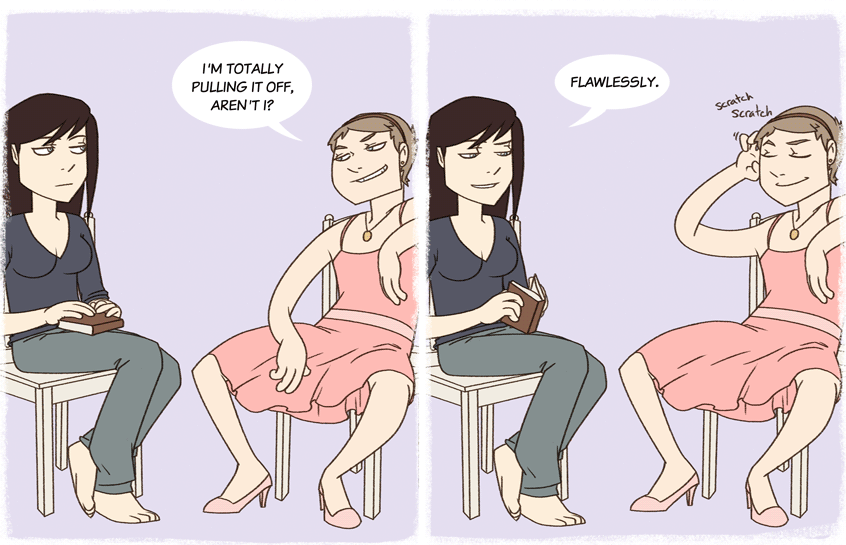
Likewise, burping and farting, raising one’s voice in an argument, and even laughing loudly are considered distinctly unfeminine.
- A feminine person doesn’t use her body to forcefully interact with the world, she lets others do for her when possible. “Massiveness, power, or abundance in a woman’s body is met with distaste,” Bartky wrote.
In groups of men, those with higher status typically assume looser and more relaxed postures; the boss lounges comfortably behind the desk while the applicant sits tense and rigid on the edge of his seat. Higher-status individuals may touch their subordinates more than they themselves get touched; they initiate more eye contact and are smiled at by their inferiors more than they are observed to smile in return. What is announced in the comportment of superiors is confidence and ease…Acting feminine, then, overlaps with performances of submissiveness.
- Both men and women use their bodies in more feminine ways when their interacting with a superior, whether it be their boss, their commander, a police officer, or their professor.
- Psychologist Andy Yap and his colleagues tested whether “expansive body postures” like the ones associated with masculinity increase people’s sense of powerfulness and entitlement. They did. In laboratory experiments, people who were prompted to take up more space were more likely to steal, cheat, and violate traffic laws in a simulation. A sense of powerfulness, reported by the subjects, mediated the effect (a robust finding that others have documented as well).
- large automobiles with greater internal space were more likely than small ones to be illegally parked in New York City.


Language & Gender
Language and Gender
Units of analysis:
· Gender Exclusive Versus Gender Preferential Language Differences
o Arawak/Carib
o Men’s languages (secret languages) associated with patrilineal cultures (LONGHOUSE)
o Trade jargons?
o Where they exist, reflect gender exclusive roles
· Sex PREFERENTIAL Problems: Sexism in Language
---Is language sexist or is culture sexist
---Is language sexist or is culture sexist
o Gender INCLUSIVE language (from psychology text)
"The intent of this is to highlight a few areas where we still find exclusivity or a sense of hierarchy in the use of language to place one group of people below others, creating or perpetuating negative social stereotypes.
 Given the spirit of inclusivity in our culture, some suggestions are provided here to avoid derogatory language. The examples are by no means comprehensive, but serve to remind us of areas where language discrimination still exists and causes unnecessary misunderstandings in our daily communication with the general public. The spirit of the "title" can be summed up in three general principles:
- Don't single out a person's sex, race, ethnicity, or other personal traits or characteristics (such as sexual orientation, age, or a disability) when it has no direct bearing on the topic at hand. In other words, don't create or promote stereotype based on unavoidable human characteristics.
- Be consistent in your description of members of a group: Don't single out women to describe their physical beauty, clothes or accessories or note a disabled person's use of an aid, or refer to the race of the only minority in a group unless it is at that individual's request.
- Keep in mind that use of inclusive language is for general cases. Direct requests by individuals take precedence over general rules (e.g., Mrs. John Doe requests that her own name not be used). "
- Making Distinctions: The good, the bad & the ugly
- Mailman?
- Actor/waiter/steward/mailman VS doctor/lawyer/professor/president
- Are there gender neutral pronouns? (guys in Philadelphia)
- Designating Status & Hierarchy:
- Does Language REFLECT gender relations?
- Does Language CREATE gender distinctions?
- A bit of both?
- SOCIAL STATUS EXPLANATIONS: women are more status conscious than men
- WOMEN AS GUARDIANS OF SOCIAL VALUES
- SUBORDINATE GROUP MUST BE POLITE
- Looking for status recognition in larger society
- Protecting “face” (Goffman)/avoiding offence to others
- Children (less power & status) also expected to use polite forms
- VERNACULAR FORMS EXPRESS MACHISMO
- Solidarity
- Carry covert prestige for men (but not for women)
- Standard forms are associated with femininity (covert power for women)
- Rejection of “school marm” (taught) speech by female teachers
- OBSERVER’S BIAS
- Women interviewed want to make a better impression (aware of status marked setting)
- Women’s “social class” may be misidentified as her husband’s
- Signaling Gender
- Structural differences
- Pronunciation
- Grammar
- Lexicon
- Homosexual speech
- Women’s Speech: Characteristics
- General
- Conservative (more standard)
- Crossover phenomenon
- Way to advance status as lower status gender?
- Raise children-provide good language role model?
- Polite/formal
- Nonverbal communication
- Kinesics
- Proxemics
- Touching (touched more often in mixed gender & touch more)
TANNEN FILM
Distinctive aspects of MALE SPEECH
- regarded as normative language
- referential and competitive
- swearing and use of taboo words acceptable
- vernacular often preferred to more correct forms
- blunt imperatives are customary
- interrupting the speech of others is usual
- bald criticism acceptable
- questions are more frequently asked
- compliments are minimized
- apologies are minimized
- language is used as a tool of power
- topics of conversation are mainly:
- politics, economics, money, carer, job, sports, cars, women, sex
- regarded as deviant language
- affective and collaborative
- hedges are common
- tag questions are common
- super polite forms are normal
- empty adjectives are used (sweet, divine, adorable)
- intensifiers are frequent (really, so, well)
- hypercorrect grammer and pronunciation are preferred
- lack of sense of humor; less joke telling
- directy speech is used (She said to me...)
- special vocabulary (colors, etc.)
- a question intonation used in declarative statements
- topics of conversation:
- self, friends, body issues, family, domestic issues, womens problems
Gender and Non-Verbal Communication
Some differences are dependent on age and culture.
-Remember, these studies are based on tendencies and cannot predict
individual behavior.
individual behavior.
Females:
- Claim less territory as their own.
- Women stand closer to each other in conversation.
- Women use more eye contact than men.
- Women use more facial expression and are generally more expressive.
- Women are more likely to return a smile when smiled at.
- Women smile more.
- Women take up less space–they hold legs more together and keep arms
close to their bodies. - Women stand farther away from people who speak loudly
- Women use fewer gestures than men.
- Women use more gestures when seeking approval.
- Women tend to cross legs at the knees or cross ankles with knees slightly apart.
- Women play with hair or clothing, and place their hands in their laps.
- Women do not necessarily interpret a man's touch as a sexual invitation
- Women tend to keep hands on the arms of a chair.
- Women are approached by both sexes more closely than are men.
Tuesday, November 1, 2016
Essay: Due 11/10: "Languaging Racism"
After reading Articulate While Black, (1) Discuss the ways is which language is a significant factor in understanding racism. (Your essay should consider among other things, "linguistic profiling", "linguistic policing", the meaning given to nonstandard English, and the various ways in which language "codes" for racist meaning). (2) How does the notion of "political correctness" undermine our ability to see language as integral in the maintenance of racism? (3) Illustrate your essay with examples from political speech in the current election cycle.
Subscribe to:
Posts (Atom)